Solo Mode Rising: Why American Gamers Are Logging Off and Going It Alone
There's a moment a lot of gamers know well. You queue up for a match, you get teamed with strangers who either ignore you or berate you, and somewhere between the third insult and the fourth loss, a little voice in your head says: why am I even doing this?
More and more American players are listening to that voice. And instead of queuing up again, they're booting up something entirely different — a story-driven RPG, a sprawling open-world adventure, a quiet narrative game that doesn't demand anything from them except their attention. The great multiplayer exodus is real, and it's reshaping what the gaming industry thinks people actually want.
The Burnout Is Real — and It's Been Building
Let's be honest about what competitive multiplayer has become for a lot of people. What started as a genuinely social experience — friends gathered around a screen, strangers bonding over shared objectives — gradually evolved into something that feels more like a second job than a hobby. Ranked ladders. Season passes. Daily login bonuses designed by psychologists to keep you coming back. Skill-based matchmaking that punishes you the moment you start improving.
The pressure is relentless, and the communities surrounding these games haven't exactly helped. Toxic behavior in online lobbies has been a documented problem for years, but the scale of it has reached a point where even dedicated players are waving the white flag. A Pew Research study found that a significant chunk of online gamers have experienced some form of harassment during multiplayer sessions. That's not a niche problem — that's a feature of the environment.
When you stack exhaustion from real life on top of that kind of gaming atmosphere, it stops feeling like an escape. It starts feeling like more stress with a headset on.
What Single-Player Games Are Offering Instead
Here's the thing about a well-crafted single-player game: it meets you where you are. You can pause it. You can walk away and come back three days later without losing your place in a social hierarchy. Nobody is going to yell at you for making a wrong turn in the story.
But beyond the obvious comfort factor, something more meaningful is drawing players back to solo experiences — genuine emotional investment. Games like Baldur's Gate 3, God of War: Ragnarök, and Elden Ring proved in recent years that players are hungry for experiences that feel authored and intentional. These aren't games that pad their runtime with repetitive objectives or live-service grind loops. They're built around a beginning, a middle, and an end. They trust the player to care.
Narrative design has gotten genuinely excellent. Writers and directors working in games today are crafting stories that rival prestige television for emotional complexity. When a game makes you feel something real — grief, triumph, moral confusion — that's a powerful argument for sitting down with it alone rather than splitting your attention across a chaotic multiplayer match.
The Industry Is Paying Attention
Publishers spent most of the last decade chasing live-service revenue models, convinced that the future of gaming was perpetual engagement loops and battle passes. Some of those bets paid off spectacularly. Others crashed and burned in ways that became cautionary tales.
But the data coming out of recent release cycles is telling a different story. Single-player titles are moving massive numbers. Sony's first-party lineup of story-driven games has consistently outperformed expectations. Microsoft has invested heavily in narrative studios. Even developers who built their reputations on multiplayer are quietly expanding into solo content.
The appetite is clearly there. And studios that ignored it — or assumed every player wanted to be part of an ongoing community — are recalibrating. The conversation inside development studios has shifted from "how do we retain players forever" to "how do we give them something worth finishing."
It's Also About Time — and How People Value It
American gaming demographics have shifted considerably over the past decade. The average age of a gamer in the US keeps climbing, and older players tend to have less discretionary time than teenagers grinding ranked matches after school. When you've got a job, maybe a family, and a list of responsibilities that doesn't quit, the idea of committing to a multiplayer game that requires consistent daily play to stay competitive starts to feel absurd.
A single-player game respects your schedule in a way that multiplayer fundamentally cannot. You put in two hours on a Tuesday night, you make meaningful progress, and you feel good about it. You don't have to apologize to a team for not being available all weekend. That kind of low-friction experience has become genuinely valuable to a huge portion of the player base.
The Social Piece Didn't Disappear — It Just Moved
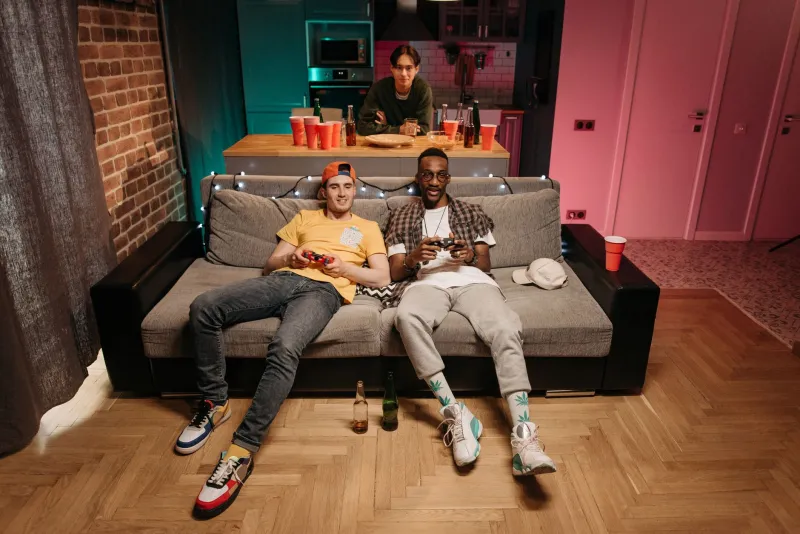
Here's an interesting wrinkle in all of this: players who've stepped back from multiplayer haven't necessarily stopped being social about games. They've just moved those conversations elsewhere. Reddit threads dissecting story choices in Cyberpunk 2077. YouTube channels dedicated to lore deep-dives. Discord servers built entirely around comparing notes on a single-player game's endings.
The community experience shifted from happening inside the game to happening around it. And for a lot of people, that's actually more enjoyable. You get to engage with other passionate fans on your own terms, without the pressure of real-time performance hanging over every interaction.
What This Means Going Forward
The multiplayer market isn't going anywhere. Games like Fortnite, Call of Duty, and League of Legends still command enormous audiences, and they'll continue to. But the idea that multiplayer was the inevitable future of all gaming — that single-player was a dying format for a niche audience — has been pretty thoroughly dismantled.
What we're seeing is a rebalancing. Players are making more deliberate choices about how they spend their gaming time, and a growing number of them are choosing experiences that feel complete, personal, and pressure-free. That's not a rejection of gaming culture. It's actually a pretty healthy evolution of it.
At PlayZone88, we've watched this shift play out in real time through the games people talk about, recommend, and come back to. And honestly? The enthusiasm around single-player titles right now feels different — more genuine, less performative. People aren't playing to rank up or flex. They're playing because a game made them feel something, and they want to talk about it.
That's what this was always supposed to be about.